
Optimize for Revenue. Not Open Rates.
Klaviyo, HubSpot, Zoho, or Brevo — deployed and orchestrated to generate measurable revenue. Lifecycle flows engineered as systems, warehouse-driven segmentation, multi-channel orchestration including WhatsApp, and deliverability treated as engineering, not marketing.
Your CRM Probably Costs You Revenue Every Week.
Not because the platform is bad — because the system around it is built to optimize the wrong things. Here's what we see again and again:
The Vanity Metric Trap
Your open rate is 35%, your click rate is 4%, and you celebrate every send. Yet your CRM revenue line stays flat quarter over quarter. You're optimizing the metrics that are easy to read, not the ones that pay.
Open ↑ · Revenue →CRM as a Graveyard
Thirty percent of your contacts are duplicates. Lifecycle stages are still set on leads who went cold 18 months ago. Consent state lives in five different places — none of them trustworthy. The CRM is full, but it doesn't know anything.
30%+ duplicate contacts is typicalDisconnected From the Warehouse
Segmentation in Klaviyo or HubSpot uses only what those tools know — recent opens, page visits, list membership. The richer signals — RFM, predictive LTV, churn risk, propensity scores — sit in BigQuery, unused. The CRM is sending to the wrong segments because it can't see the right ones.
Best segments live outside the CRM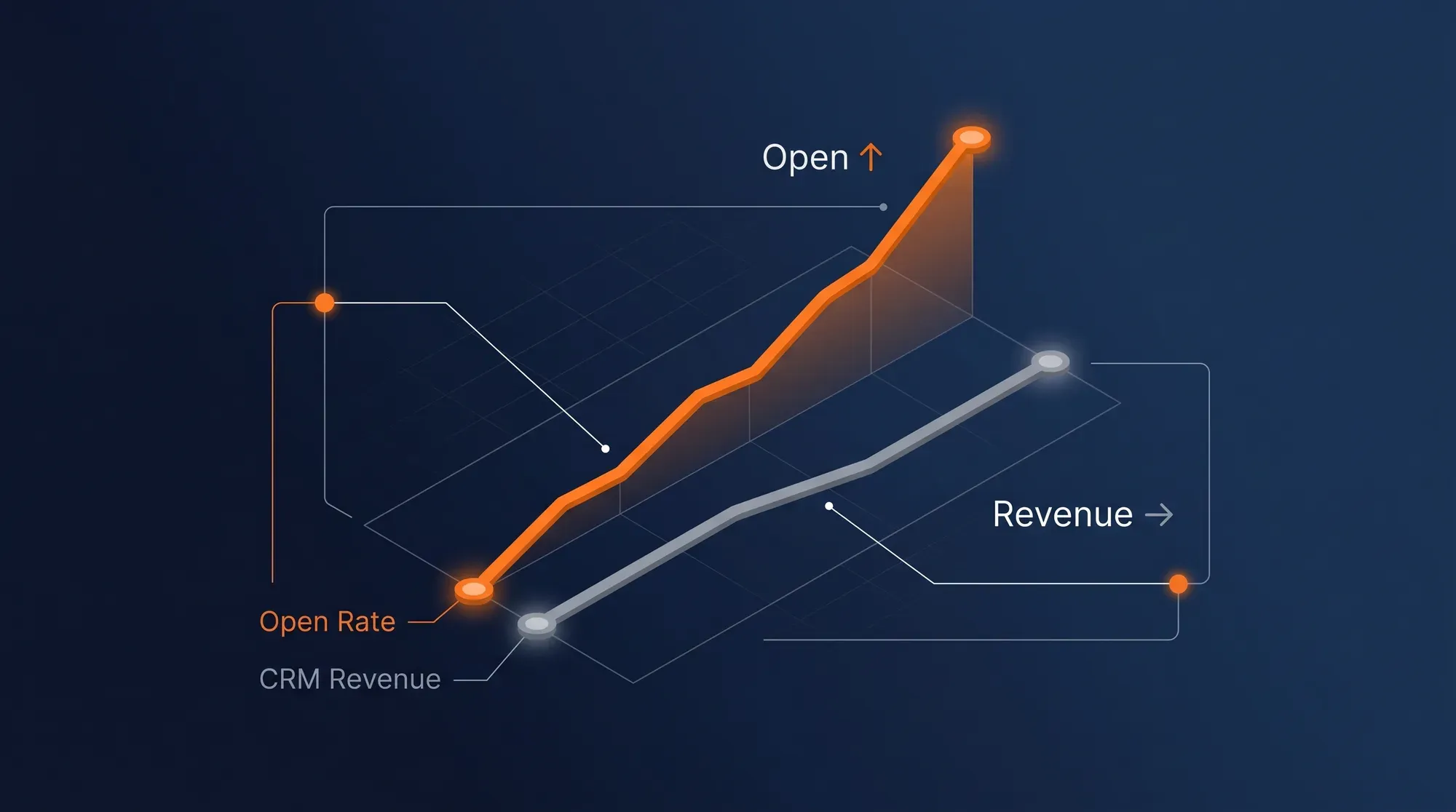
Four Pillars of a CRM Program That Pays
We don't set up Klaviyo and call it a day. We build the system that makes it print money — flows, segmentation, deliverability, and attribution working together.
Revenue Attribution — Per Flow, Per Segment
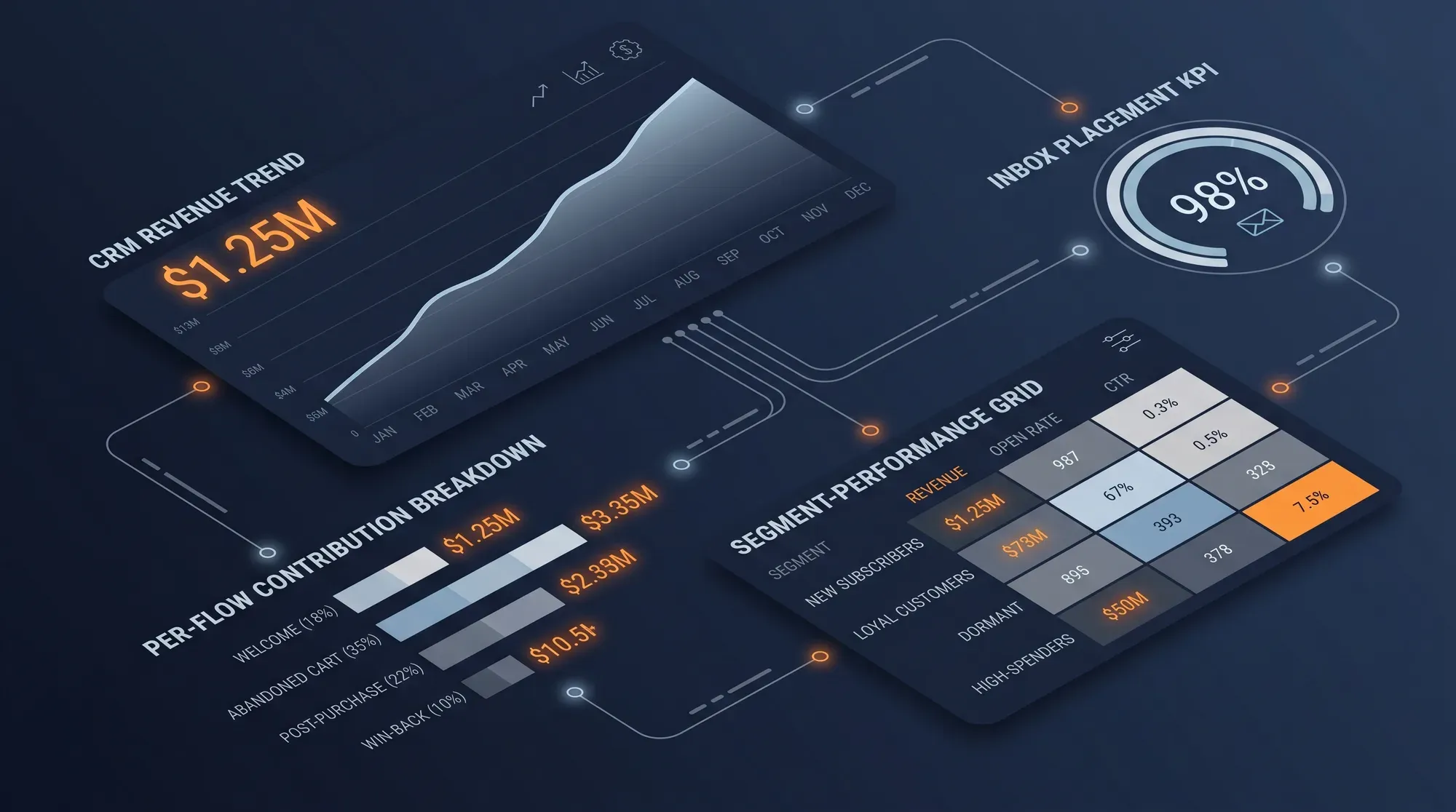
Every CRM-sourced sale linked back to the flow that drove it, not just the last open. We build a revenue dashboard on top of your warehouse where you can see — per lifecycle flow, per segment, per cohort — what each piece of your program contributed last month. The "vanity vs revenue" gap becomes visible and addressable.
Impact → True ROI per flow · Decisions on revenue not opens · Sunset what doesn't pay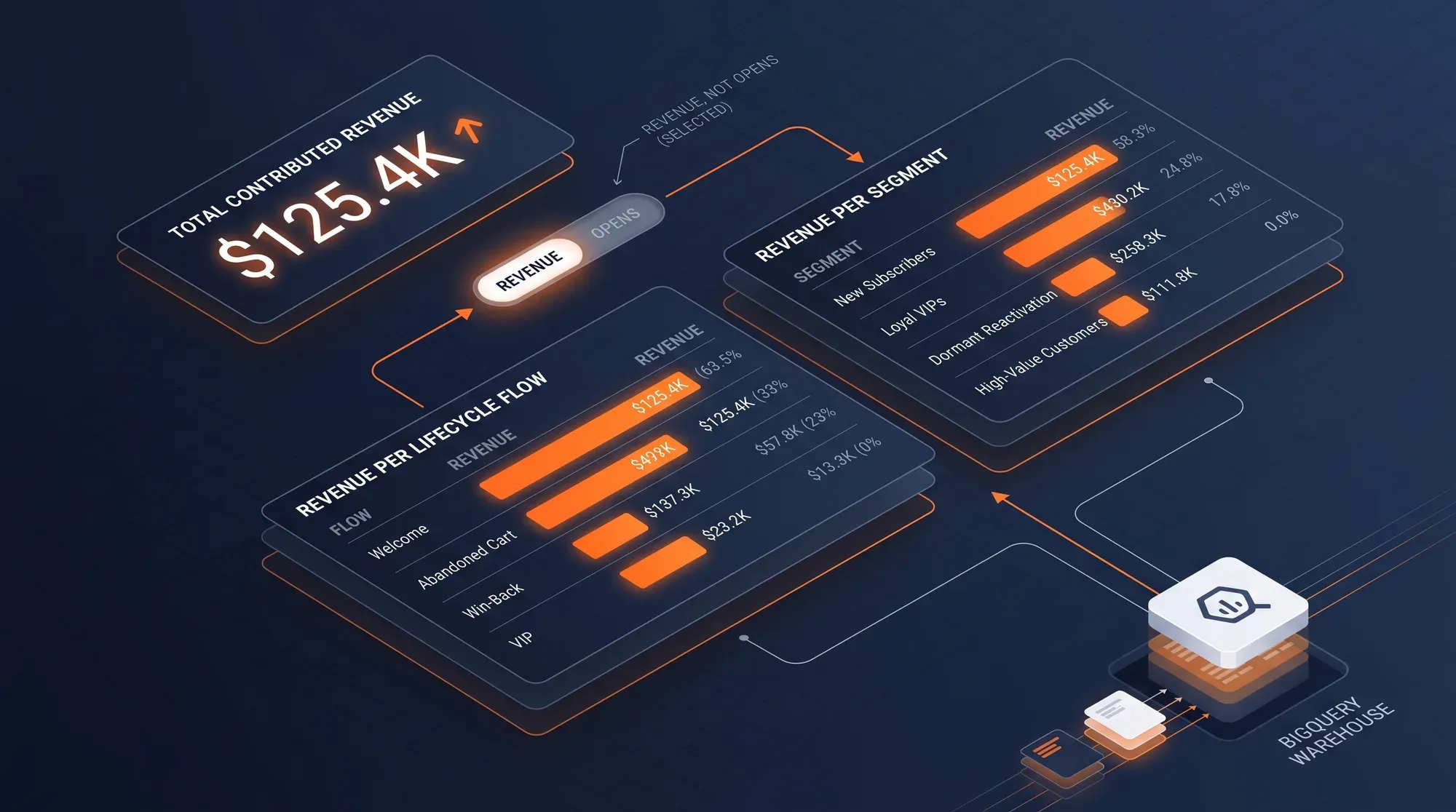
Lifecycle Orchestration — Systems, Not Campaigns
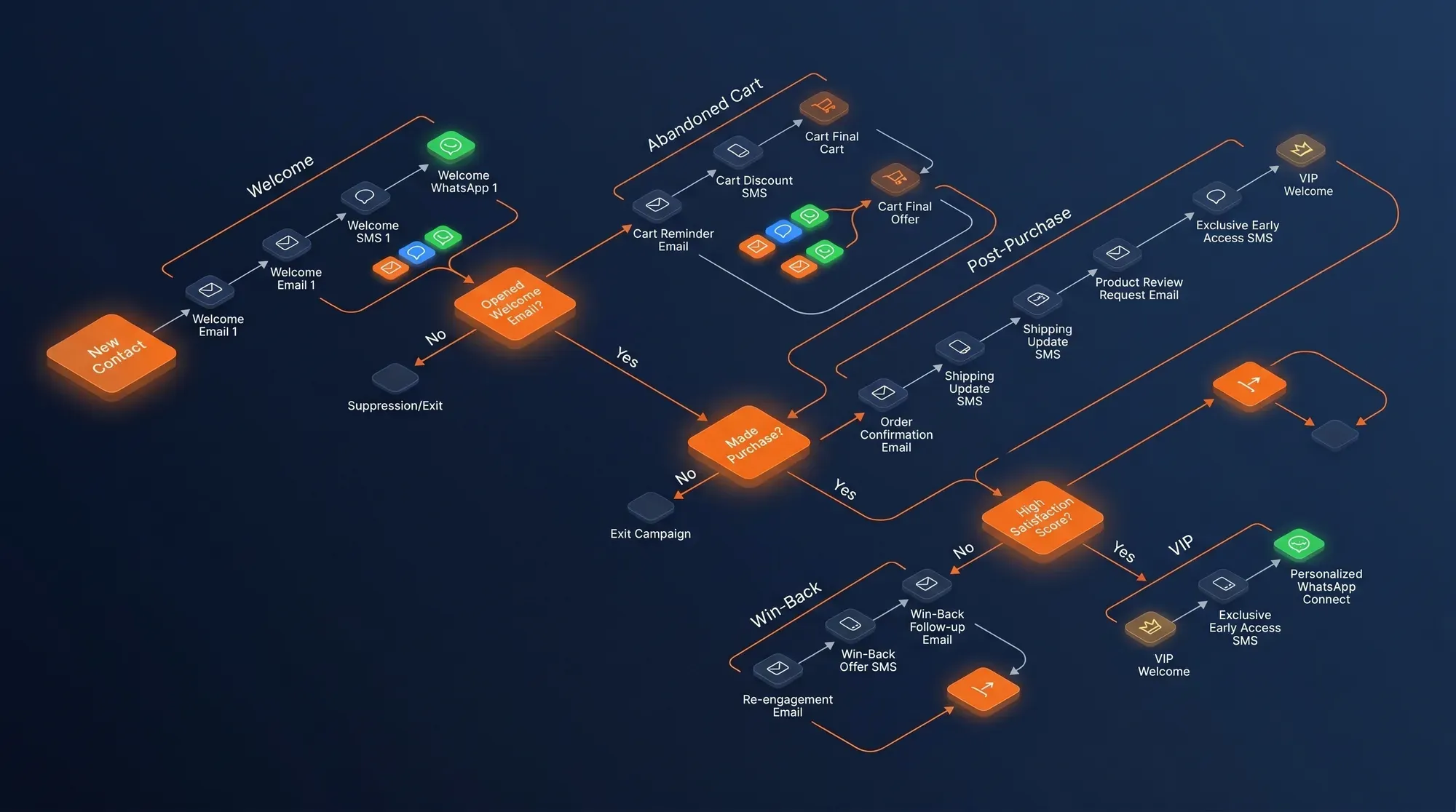
Welcome, abandoned cart, browse abandonment, post-purchase by product type, win-back tiered (30 / 60 / 90 days), VIP nurture, churn rescue. Each flow is designed as a system with explicit entry rules, branching logic, suppression conditions, and exit criteria. WhatsApp automation runs in parallel to email where it converts better — same canonical customer profile driving both.
Impact → 8–12 flows compounding revenue · Suppression handled · Multi-channel by design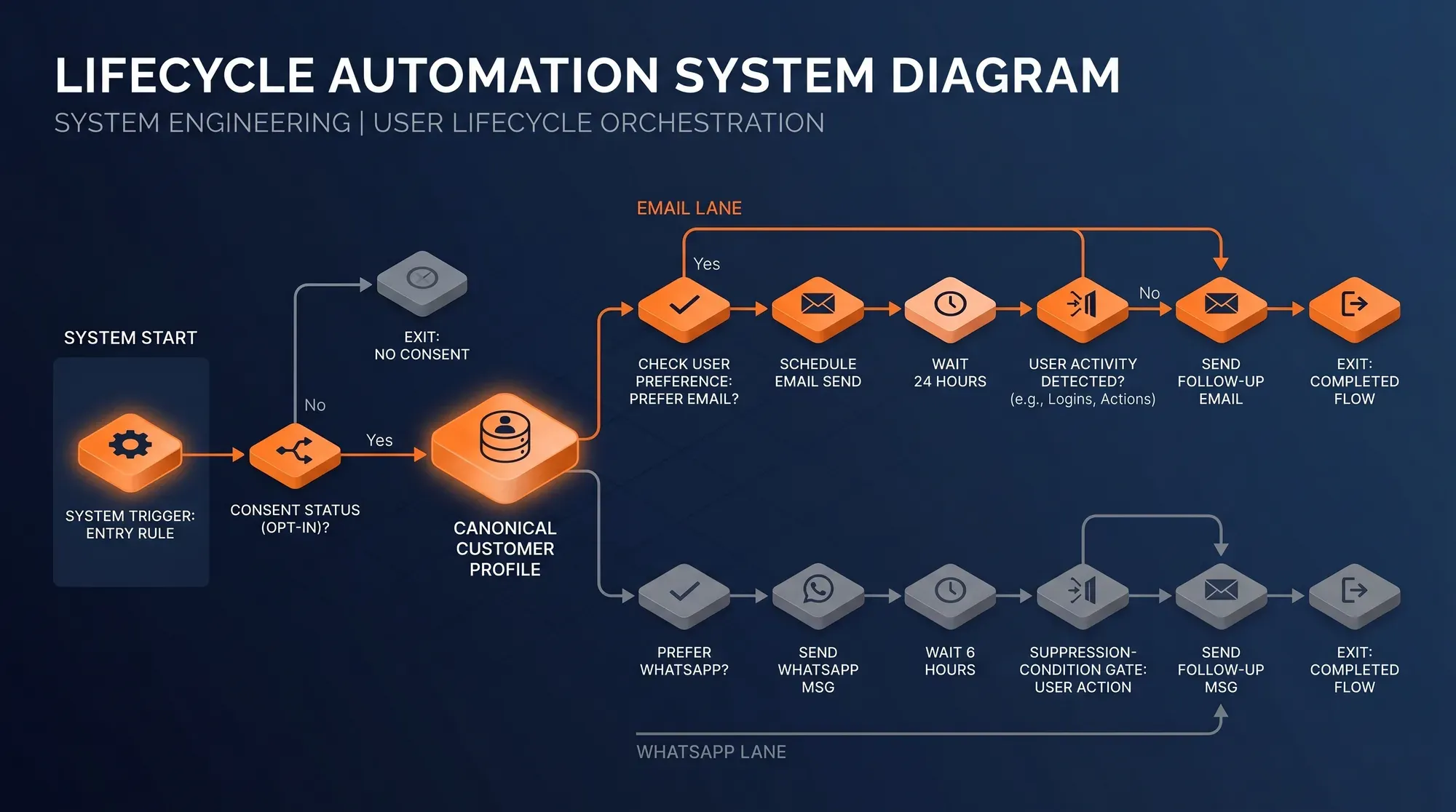
Warehouse-Driven Segmentation
RFM scores, predictive churn, LTV cohorts, and propensity-to-buy scores live in BigQuery — far richer than anything Klaviyo or HubSpot can compute internally. We push them into the CRM via Reverse ETL (this is where the CDP & Architecture work compounds). Your CRM finally segments using your warehouse intelligence, not just its own narrow view.
Impact → CRM sees what BigQuery sees · Daily-refreshed audiences · One segment definition everywhere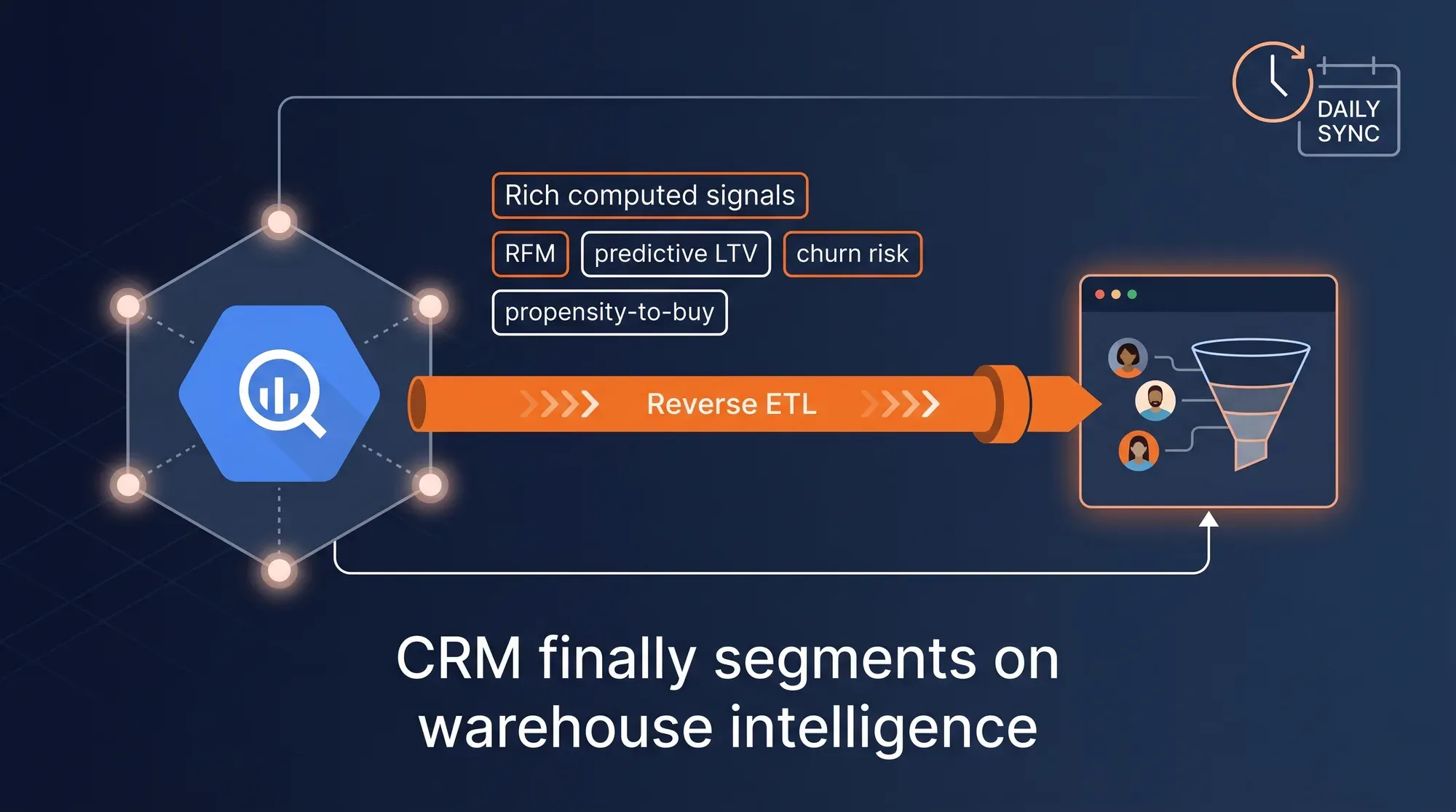
Deliverability as Engineering
Most CRM programs fail not because the copy is bad, but because the email never reaches the inbox. We configure full DNS authentication — SPF, DKIM, DMARC progressed to p=reject, BIMI with a verified logo where it makes sense. We run structured IP / domain warm-up if you're on new sending infrastructure. We monitor inbox placement continuously via Google Postmaster Tools and Sender Score. A/B tests are run with proper statistical significance, not the "B won by 0.3%" guessing the platforms ship by default.
Impact → 99%+ inbox placement · Reputation defended · Tests that actually prove something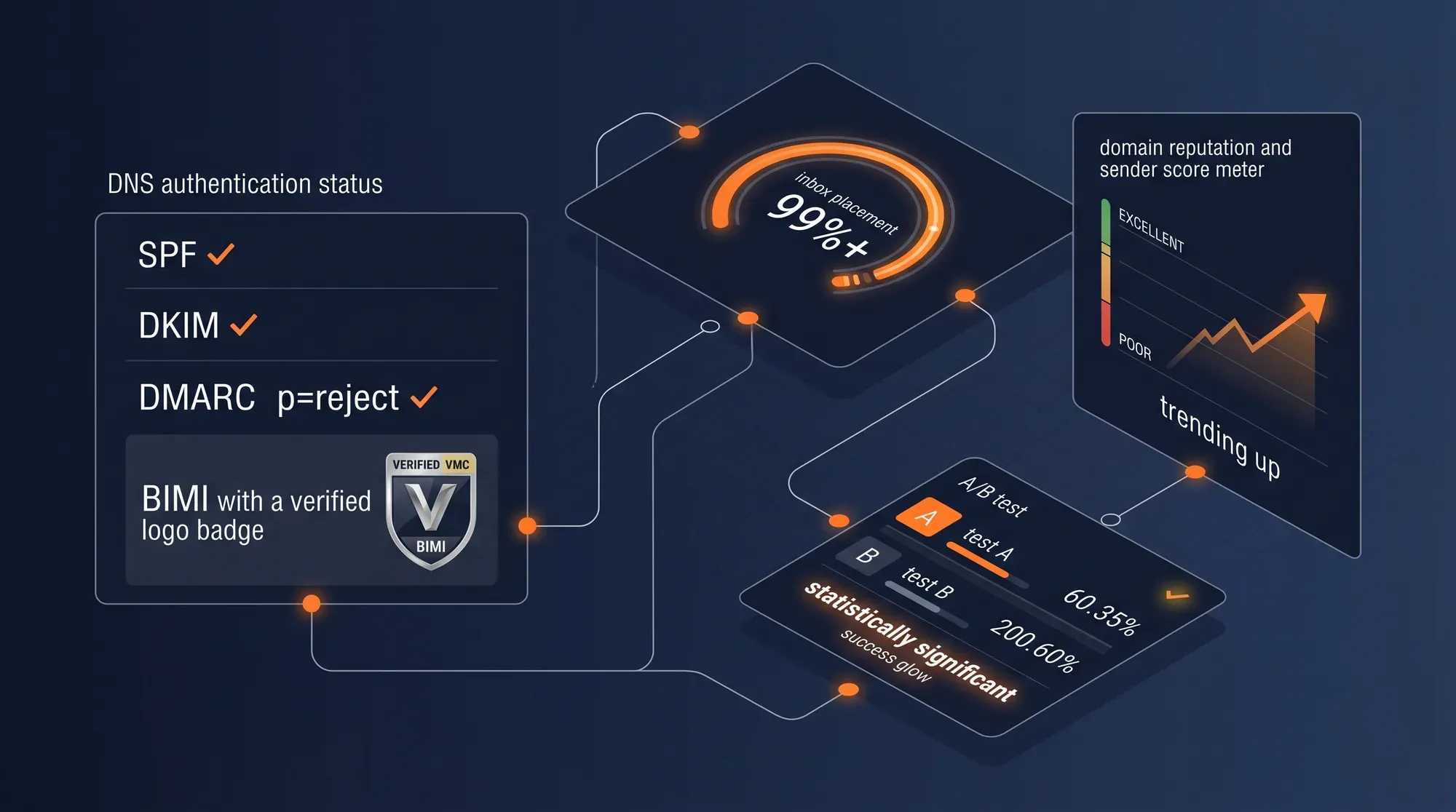
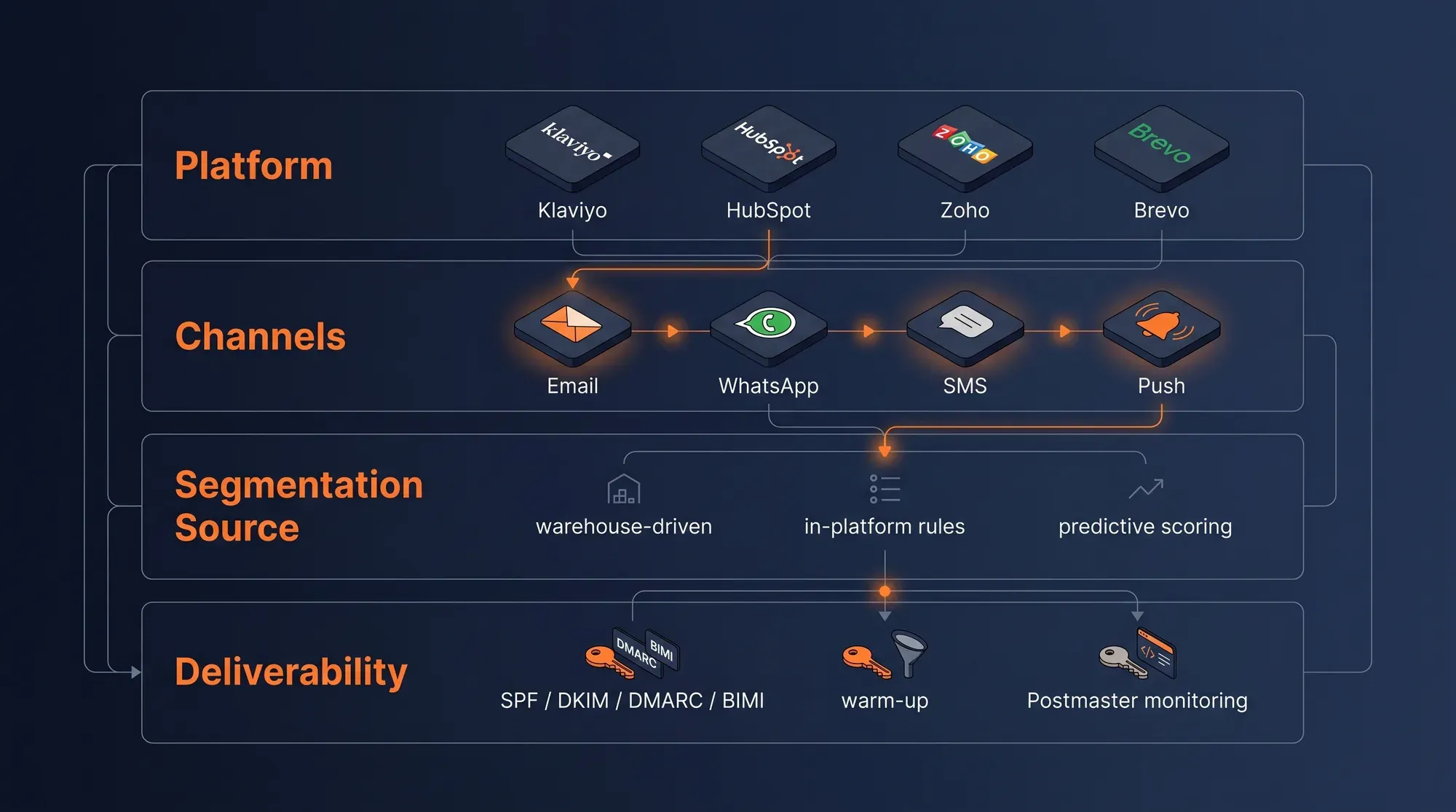
The Four Layers of a Revenue-Optimized CRM Program
Platform, channels, segmentation source, and deliverability. Most teams build one or two of these well. Building all four is where the revenue compounds.
Platform
The CRM / ESP / Marketing automation tool itself. Choice driven by ICP, integrations, and pricing model.
- KlaviyoE-commerce · deep Shopify integration
- HubSpotB2B · lead gen · pipeline
- Zoho CRMMid-market · cost-efficient full suite
- Brevo (ex-Sendinblue)High volume · EU residency
Channels
Where your messages reach the customer. Each channel has its place — and its cost-per-engagement.
- EmailFoundation · cheapest scale
- WhatsApp + AutomationHigh intent · markets where messaging > email
- SMS via MessageBirdTransactional + high-value triggers
- Push / In-appMobile-first brands
Segmentation Source
Where your audiences are computed. Mix of warehouse intelligence and in-platform real-time triggers.
- Warehouse-drivenReverse ETL from BigQuery · RFM / LTV / churn
- In-platform rulesReal-time triggers · abandoned cart · browse
- Predictive scoringLikelihood-to-buy · churn risk · custom models
Deliverability
The engineering layer most agencies skip. Without this, the rest doesn't reach the inbox.
- DNS auth (SPF/DKIM/DMARC/BIMI)Foundational · DMARC progressed to p=reject
- IP / domain warm-upStructured ramp · 2–4 weeks
- Google Postmaster + Sender ScoreContinuous reputation monitoring
- Inbox placement testingGlockApps / 250ok seed accounts
Our Implementation Methodology
A proven 6-step process — from audit to a revenue-attributed CRM program that compounds, in 6 to 10 weeks.
CRM Audit
3–5 daysWe assess your current setup — deliverability score, DNS auth status, flows in place, contact hygiene, lifecycle stages, integrations. We map the gap between what you have and what a revenue-optimized program looks like, with a quantified opportunity figure.
Strategy & Lifecycle Design
1 weekLifecycle map per persona — what flow runs when, what channel mix (email / WhatsApp / SMS), what entry and exit criteria. Frequency caps to avoid fatigue. Suppression rules to never re-engage someone who just bought or opted out. Documented before any flow is built.
Platform Setup / Migration
1–2 weeksDNS authentication configured (SPF / DKIM / DMARC progressively to p=reject, BIMI if applicable). Account architecture set up — lists, properties, integrations to Shopify / CRM / warehouse. If migrating from another platform, structured cutover with parallel running and validation.
Lifecycle Flows Build
2–3 weeksThe 8–12 revenue-driving flows built, tested in staging, and launched: Welcome, Abandoned Cart, Browse Abandonment, Post-Purchase (per category), Win-Back tiered, VIP nurture, Churn Rescue. WhatsApp automation flows in parallel where the channel converts better than email.
Warehouse Integration
1 weekReverse ETL from BigQuery to the CRM platform configured. RFM, predictive churn, LTV cohorts, and propensity scores synced daily. Audiences in the CRM finally reflect what the warehouse knows — not just what the CRM has observed.
Attribution & Reporting
1 weekRevenue dashboard built on the warehouse: revenue per flow, per segment, per cohort, per channel. Deliverability KPIs (inbox placement, reputation, bounce rates) tracked continuously. A/B test framework with statistical significance baked in. Team trained, runbook handed over.
What's included
Platform Deployed or Migrated
Klaviyo, HubSpot, Zoho, or Brevo — installed, configured, integrated with Shopify / your stack / your warehouse. If migrating, full cutover with parallel run and zero data loss.
DNS Authentication Suite
SPF, DKIM, DMARC progressed to p=reject, and BIMI with a verified logo where it adds value. Inbox placement protected from day one.
8–12 Lifecycle Flows Live
Welcome, abandoned cart, browse abandonment, post-purchase per category, win-back tiered, VIP, churn rescue — each documented, tested, and measured against revenue impact.
WhatsApp Automation Flows
Where the channel beats email — high-intent moments, abandoned checkout for high-AOV, post-purchase confirmations, win-back to engaged subscribers. Same canonical customer, same revenue dashboard.
Warehouse-Driven Segments
5–10 audiences computed in BigQuery and synced daily — RFM, predictive churn, LTV cohorts, propensity scores. The CRM finally segments with full intelligence, not in-tool guessing.
A/B Framework with Statistical Significance
Sample size calculated before each test. P-values computed properly. No more "Variant B won by 1%" calls that turn out to be noise. Tests that actually prove what they claim.
Who this is for
E-commerce Brand
You run on Klaviyo (or should) and your email contribution to revenue is somewhere between underwhelming and unknown. We build the full system on top of your Shopify data and your warehouse intelligence:
- Abandoned cart with personalized product recos drawn from RFM segment + browse history
- Post-purchase flows branching on product category, AOV, and predicted next purchase
- Win-back tiered at 30 / 60 / 90 days, with offers that scale with churn risk
- WhatsApp automation in parallel — same flows, same suppression, the channel that converts
- SMS via MessageBird for transactional + high-value moments only
Lead Gen / B2B
HubSpot is the engine, but it's probably underused — full of leads in stages no one updates, no real attribution from marketing to closed-won. We turn it into a revenue system:
- Lead scoring tied to firmographic enrichment and behavioral signals from the warehouse
- MQL → SQL handoff automated with clear criteria, no more "who owns this lead?"
- Lifecycle stage transitions triggered by warehouse events, not in-tool manual rules
- Sales sequence orchestration tied to where the lead actually is in their journey
- Revenue attributed from first touch to closed-won — across email, ads, sales activity
Digital Agency
You run CRM for 8–15 clients, each on a different platform, each with its own consent regime and brand voice. We build a multi-client operating model that scales:
- Templated flows per industry — e-commerce, B2B, hospitality — adapted per client in days
- Centralized deliverability monitoring across the client book — one dashboard, all reputations
- Consolidated revenue reporting per client, white-labeled for QBRs
- Multi-channel orchestration consistent across the agency — same playbook, every account
What to expect
0–15%
Revenue lift from lifecycle flows
0%+
Inbox placement rate
Daily
Warehouse-driven segment refresh
Case Studies
Case study coming soon
Case study coming soon
Frequently Asked Questions
Ready to Make Your CRM Print Money?
Get a free CRM audit. We'll measure your deliverability, map your current flows against revenue, and show you the gap a properly engineered program would close.